
How Are ELTs Activated?
Emergency Locator Transmitter (ELT), according to COSPAS-SARSAT standards, can be of types such as Automatic Fixed (ELT-AF), Automatic Portable (ELT-AP), Survival (ELT-S) and Deployable (ELT-DT). All of these except the Survival type ELT-S have crash/damage detection and automatic activation features. According to the current COSPAS-SARSAT standard, automatic activation must be provided when acceleration of 2.3g or above is detected in any direction of the aircraft.
ELTs contain accelerometer sensors to detect acceleration above 2.3g. Since the 1980s, these sensors have generally contained a G-Switch structure consisting of mechanical components, and the probability of false alarms has been increasing as the usage duration extends.
The False Alarm Problem of ELTs
The false alarm problem of ELTs is a distracting problem for aviation traffic. In this context, it is classified at DAL-D safety criticality level within the scope of the RTCA DO-178 standard in flight projects. Click here for detailed information about DO178.
But how successfully do ELTs perform this crash detection? A 2013 report by the Australian government provides important numerical data regarding the frequently occurring false alarm problem in ELTs.
According to a report published by the Australian Transport Safety Bureau in 2013, the main causes of the ELT non-activation / false alarm problem are:
- The ELT manufacturer choosing a single-axis G-Switch
- Incorrect installation of the ELT on the aircraft
- Depleted battery and insufficient maintenance by technical teams
- Insufficient waterproofing & mechanical durability
- Damage to the connection between the ELT and the aircraft-mounted antenna during a crash
- Damage to the ELT antenna
- Soft landing of the aircraft through pilot effort during a crash
According to the numerical data presented in the same report, activation was achieved up to 40% in crash incidents where ELTs should have been activated until 2009. However, depending on technological developments, since 2009, 52% activation, 24% unreported incidents, and 24% non-activation statistics have been observed in crash incidents. As can be seen, there has been a significant improvement in terms of ELT activation in crash incidents, but there is still a very serious rate of non-activation problems.
When examining ELT performance by crash type (Figure-1), the highest activation rate is observed in forced landings and ground impact incidents (~40%), while the lowest activation rate is observed in in-flight aircraft breakup and pilot-controlled soft landings (~20%).
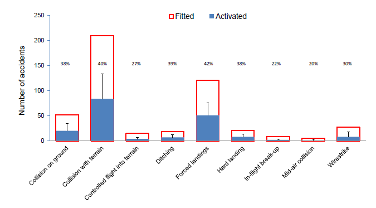
Essentially, these data are not surprising when considering incidents in aviation history. In cases of aircraft breakup in flight, the acceleration required for automatic activation of the ELT cannot be achieved; furthermore, due to the nature of such crashes, there is also no time remaining for manual activation of the ELT by the flight crew. Similarly, in pilot-controlled soft landings, the acceleration required for automatic activation of the ELT is generally not achieved. Therefore, it is clear that ELTs need manual activation in such incidents.
How Can False Alarms Be Prevented?
In light of this information and crash details, the following design principles can be considered by an ELT manufacturer company to overcome the non-activation problem in Emergency Locator Transmitter equipment:
-
- Using semiconductor – micromachined based G-Switch sensors instead of mechanical ones in the ELT
- Using three-axis G-Switch sensors instead of single-axis in the ELT
- The ELT having a navigation unit and including position information in the distress message sent to COSPAS-SARSAT
- The ELT providing a digital interface enabling manual activation by the cockpit ELT control panel
- The ELT having both its own portable antenna and providing an interface to connect to an aircraft-mounted external antenna
Regarding the G-Switch technology mentioned in the first item; until the 2000s, G-Switch sensors with mechanical components were preferred in ELTs. This situation is thought to have had a direct impact on the non-activation & false alarm incidents occurring in ELTs, as corrosion-related quality degradation, sensitivity to environmental effects, etc. were observed in such G-Switch sensors. Today, thanks to developments in materials engineering and nanotechnology disciplines, semiconductor-based micromachined G-Switch sensors have emerged and are preferred in many industrial applications. In the report presented by the Australian Government, this factor is estimated to have been effective in the statistical performance improvement of ELTs from 2009 to the present.
Pharus Tech, as a company that designs and manufactures Emergency Locator Transmitters, has developed products in light of the above solutions, taking into account the crash incidents and ELT problems that have occurred from the 1970s to the present. The Pharus P406-1 EAF Alpha Emergency Locator Transmitter product has been designed based on these principles.
References
COSPAS-SARSAT Standards
"A Review of The Effectiveness of Emergency Locator Transmitters in Aviation Accidents", Australian Government – Australian Transport Safety Bureau, AR-2012-128, 2013.
Author: Ali Doğan ([email protected])