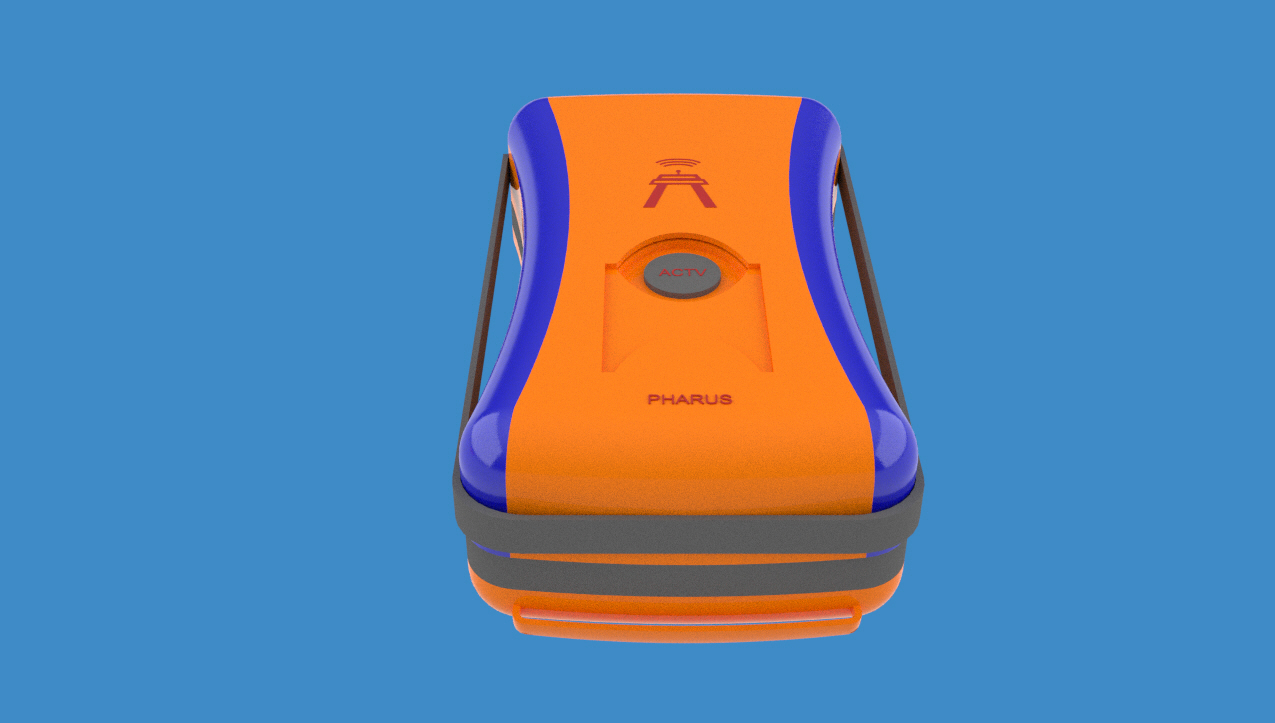
What is a PLB?
Personal Locator Beacon (PLB) is a satellite communication device commonly known by the PLB abbreviation. In environments where civilian communication equipment such as phone, internet, etc. are unavailable (forests, mountainous regions, off-city terrain, open sea, ocean, etc.), it enables calling for help through the international COSPAS-SARSAT satellite system by sending a signal to space in case of an emergency.
The COSPAS-SARSAT satellite network system, established in the 1980s through a partnership between the USA, France, and Soviet Russia, and expanding in scope over the years, is currently active in 47 countries.
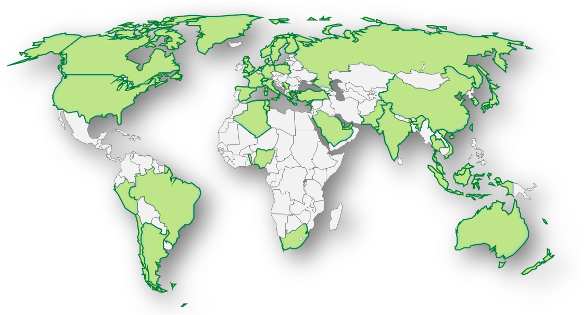
COSPAS-SARSAT system participant countries
PLBs are used to save the lives of individuals engaged in camping, mountaineering, hiking, and maritime activities without delay.
PLB Usage Areas
The COSPAS-SARSAT system provides emergency assistance service through ELT in aircraft and helicopters, and EPIRB devices in boats and ships. The most fundamental difference of these devices from PLBs is their resistance to environmental factors such as mechanical shock – mechanical impact – acceleration – temperature. Additionally, many ELT and EPIRB models have automatic activation features: For example, ELTs detect a crash when acceleration above 2.3g is observed and automatically activate to send a distress signal to the COSPAS-SARSAT system. Similarly, EPIRBs automatically activate when they detect water flooding at their location on a ship or boat.
PLBs do not have an automatic activation function. Since they are not specific to any vehicle, they send a distress signal entirely through manual activation by the user. ELTs and EPIRBs, due to the engineering and test-certification processes spent on their design for both automatic activation capability and resistance to destructive environmental conditions, can be much more costly compared to PLBs.
Consequently, international maritime and aviation authority organizations allow PLBs to be used instead of ELTs or EPIRBs on aircraft and ships in certain scenarios and constraints. This situation, due to the cost advantage, has also opened the way for aviation and maritime companies to use PLBs in some cases.
Situations where PLB usage is appropriate are as follows:
- Individuals participating in activities such as camping, mountaineering, hiking
- Individuals and companies working in off-city areas where phones have no signal
- Small aircraft carrying fewer than 2 passengers, not exceeding 8 tons with displacement load
- Aircraft in testing, certification, or design-development stages
- Aircraft with a local flight plan not exceeding 50 NM (~90 KM) from the departure point
- All maritime vessels smaller than 10 meters not exceeding 2 NM (3.6 KM) from shore
PLBs send a signal to the COSPAS-SARSAT system in the UHF band upon emergency distress call activation, transmitting position and identity information. This signal transmission must last longer than 24 hours. Pharus Tech is developing a PLB product with up to 48 hours of signal broadcasting capability and waterproof features. Planned to be certified and launched in four separate configurations—Lamda, Hermes, Ares, and Heracles—these PLBs are anticipated to offer many advantages in both cost and technical specifications.
How to Use a PLB
In Pharus Tech PLBs, as shown in the animation alongside, 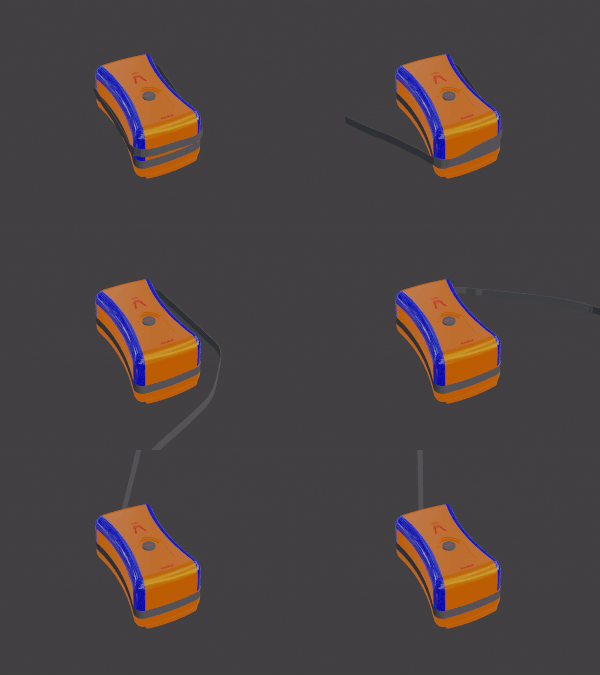 before making the emergency distress call, the antenna must be deployed and positioned so that the antenna is pointing straight up at the sky. By pressing the activation button to activate the device, signal transmission containing position and identity information to the COSPAS-SARSAT system will begin. It is strongly recommended to place the activated PLB in a fixed position on dry ground at a point where it has a clear view of the sky.
The time for the COSPAS and SARSAT system to see the emergency distress call from your PLB varies depending on your location and the position of satellites in space at that moment. Following the start of your PLB's emergency distress signal transmission, detection of your emergency by COSPAS and SARSAT is expected within a period of 30 minutes to 4 hours. After the COSPAS – SARSAT system detects the emergency, the emergency is immediately reported to the relevant government authority of the country where you are located. Search and rescue teams are directed to come directly to the location transmitted by your PLB.
Before going to an environment where a PLB might be needed, you need to ensure that your PLB will function properly. Battery insufficiency, antenna disconnection, mechanical damage to the device, etc. can cause the PLB to not function. In such a case, the PLB will not be able to provide the necessary signal despite your need. PLBs have a "Test" button to ensure that your PLB will function properly. By pressing the Test button, you can determine whether your PLB is ready for use. Detailed information about this will be included in the relevant PLB's user manual.
Important Warning: By pressing the Test button on PLBs, you cause a certain amount of battery consumption. For this reason, many PLB manufacturers specify a maximum number of Tests for PLBs for which they guarantee a certain service life. Performing Tests beyond this number may cause the PLB's battery to drop below a critical level. Battery replacement in PLBs is a vital process that must be performed by the manufacturer or manufacturer-authorized companies. Therefore, unnecessarily testing your PLB multiple times may result in you having to send the device back to the manufacturer for battery replacement and paying a service fee.
Pharus Tech PLB has a 5-year service life and allows 20 Tests within its 5-year service life. Pharus Tech's planned future certified Zeus PLB is targeted to have a 10-year service life and over 40 Test limit.
Publicly available data published by the international COSPAS-SARSAT organization shows that, on average, more than 3,000 lives are saved each year thanks to Emergency Locator Transmitters.
In a situation where you are stranded, regardless of the environment you are in, PLB devices will be a source of hope for you.
Author: [email protected]